Command Germany or the Allies in a war for Europe. 2–4 players.
The short version
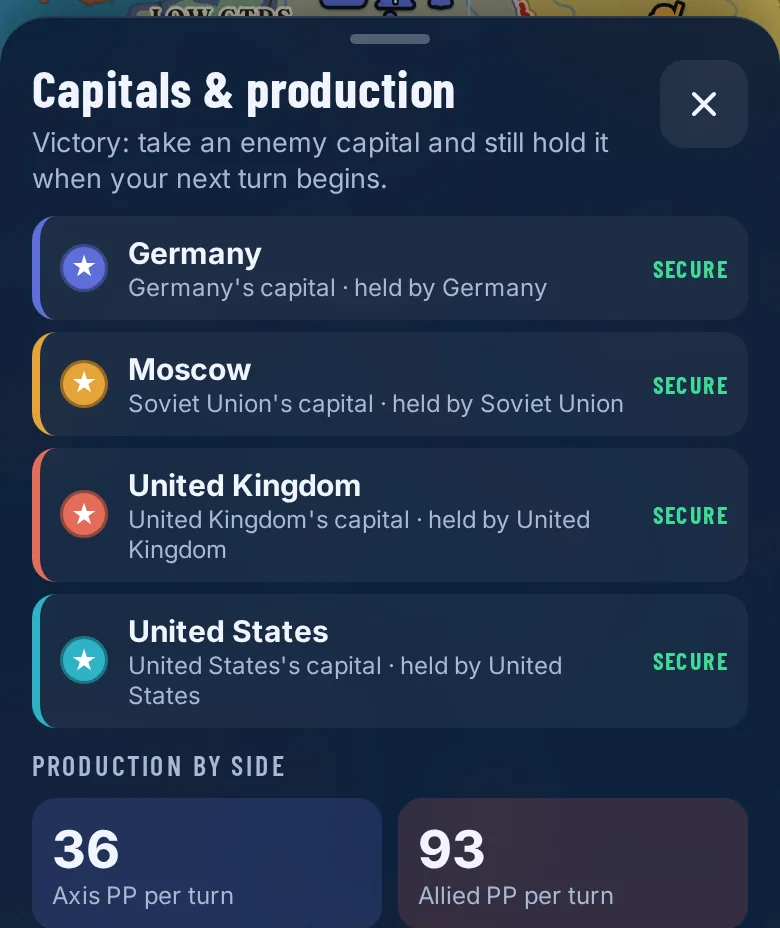
- Take an enemy capital and still hold it at the start of your next turn, while still holding your own.
- Germany wins with Moscow, the UK, or the US. The Allies win with Germany.
- On a turn you buy, send attacks, fight, move, deploy, repair fleets, then collect income.
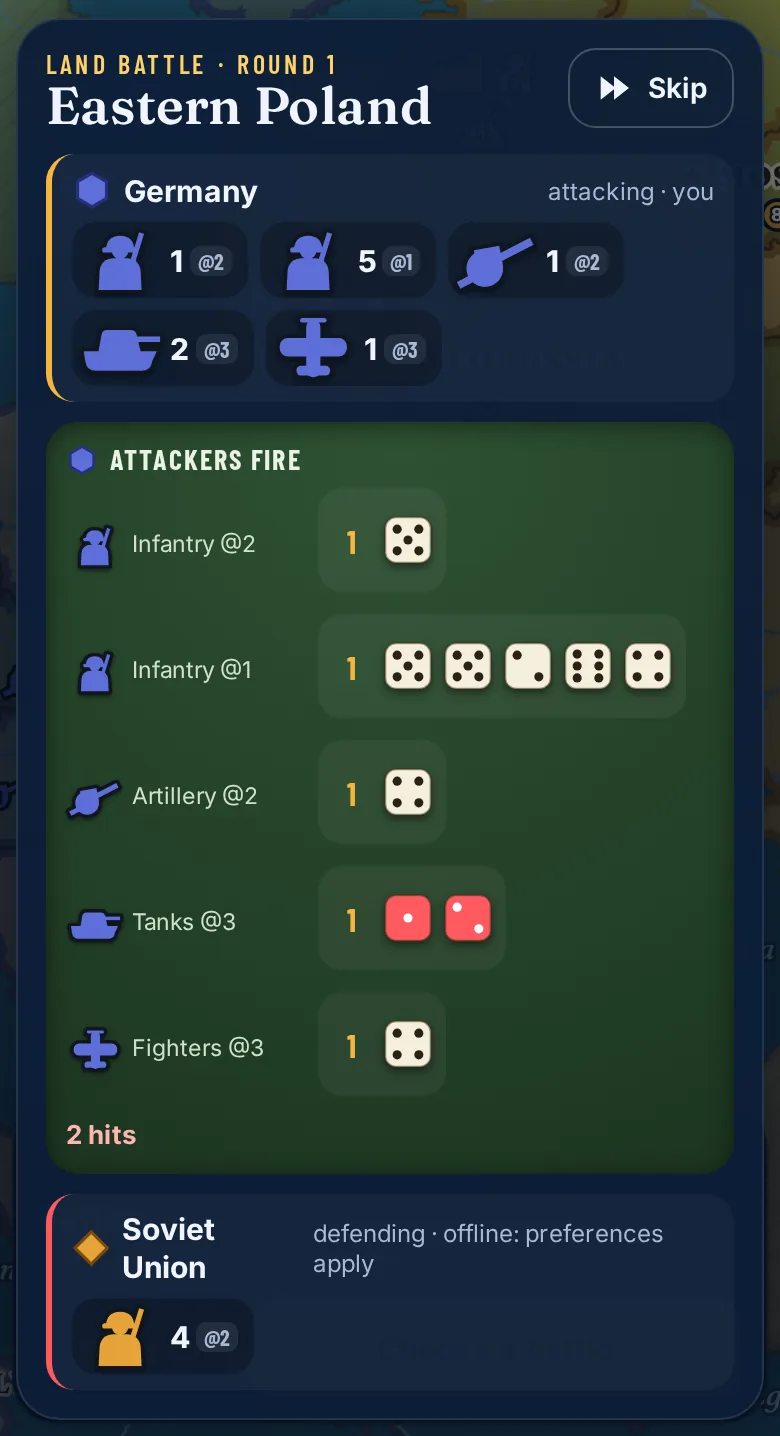
- A hit is a 6-sided die equal to or under attack (when you strike) or defence (when you hold).
- Empty enemy land with your troops is taken with no roll.
Units
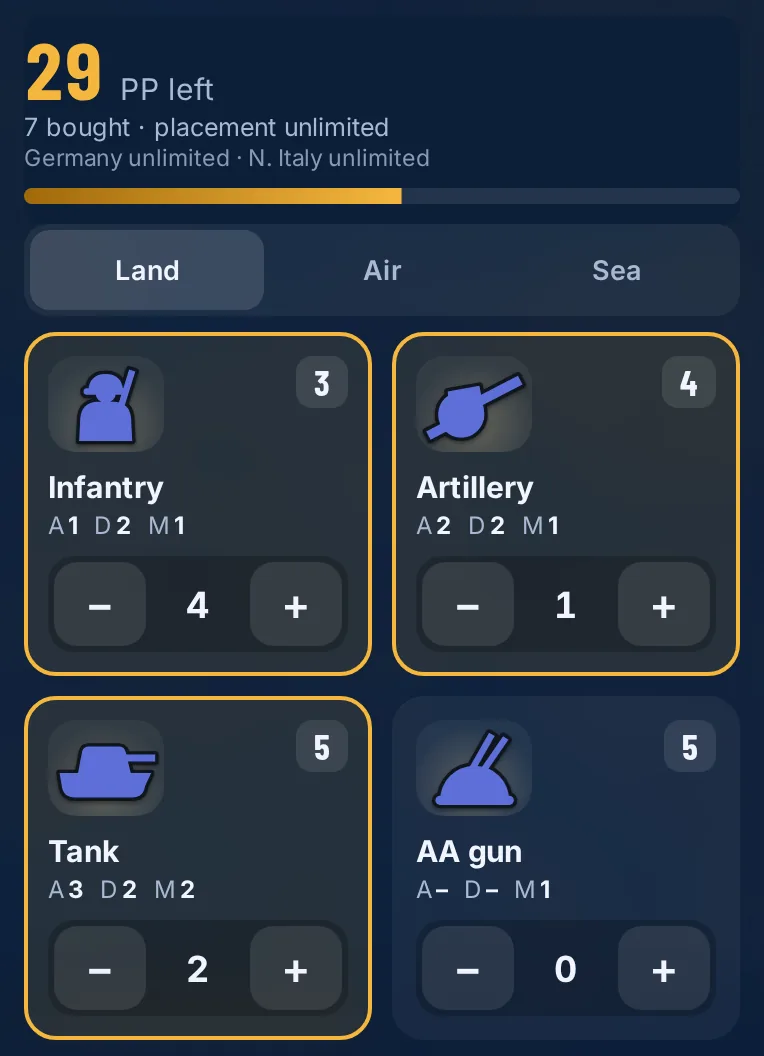
 InfantryMove 1 · Attack 1 · Defence 2 · Cost 3Foot soldiers. Attack at 2 when paired one-for-one with attacking artillery.
 ArtilleryMove 1 · Attack 2 · Defence 2 · Cost 4Guns. Each one lifts a single attacking infantry to attack 2.
 TankMove 2 · Attack 3 · Defence 2 · Cost 5Fast armour. Can blitz through one empty enemy land space, unless an enemy AA gun is there.
 AA gunMove 1 · Attack 0 · Defence 0 · Cost 5Never a casualty. Fires once at each enemy plane that enters or crosses, hitting on 1.
 FighterMove 4 · Attack 3 · Defence 4 · Cost 12Air cover. Lands on carriers. Escorts at 1; intercepts raids at 2.
 BomberMove 6 · Attack 4 · Defence 1 · Cost 15Long-range strike. Each bomber that gets through a raid knocks production points off that power.
 SubmarineMove 2 · Attack 2 · Defence 2 · Cost 8First strike when attacking, unless a destroyer is there. May dive. Cannot hit planes.
 DestroyerMove 2 · Attack 3 · Defence 3 · Cost 12Stops attacking submarines' first strike and lets planes hit submarines. Shore fire at 2.
 TransportMove 2 · Attack 0 · Defence 1 · Cost 8Carries one tank alone, or two other land units. Cargo sinks with the ship.
 CarrierMove 2 · Attack 1 · Defence 3 · Cost 18Holds two fighters.
 BattleshipMove 2 · Attack 4 · Defence 4 · Cost 24Takes two hits; repaired at fleet reset. Shore fire at 4.
Full rules
Who plays what
- Four powers always take part, in this order: Germany, the Soviet Union, the United Kingdom, the United States.
- Germany is the Axis. The other three are the Allies.
- 2 players — Germany versus all three Allies as one player.
- 3 players — Germany, the Soviet Union, and a shared UK & USA player.
- 4 players — one power each.
- A power that isn't played by a person is run by the computer, with the same rules and the same dice.
Before round 1
- Each side gets 12 extra PP to place as bonus units, on spaces that power already occupies.
- Unspent PP go into that power's treasury.
- Germany places its own 12.
- The Allied pool is shared; a common split is Soviet Union 6, United Kingdom 3, United States 3, and players may hand leftover points to an ally.
- Starting treasuries, matching opening land income: Germany 40, Soviet Union 24, United Kingdom 25, United States 40.
Victory, in full
- At the start of a power's turn, any capital that power captured earlier and still holds is checked.
- If Germany still holds an Allied capital, and still holds Germany, the Axis wins.
- If an Allied power still holds Germany, and still holds its own capital, the Allies win.
- Capitals are Germany, Moscow, the United Kingdom, and the United States.
- Taking a capital also seizes that power's remaining treasury.
The seven phases
- Purchase. Spend treasury PP on units. They go into a pool; they are not on the map yet. You cannot buy if your capital is gone. Ships need a coastal factory you can deploy from. You cannot buy a new factory — factories are already on the map.
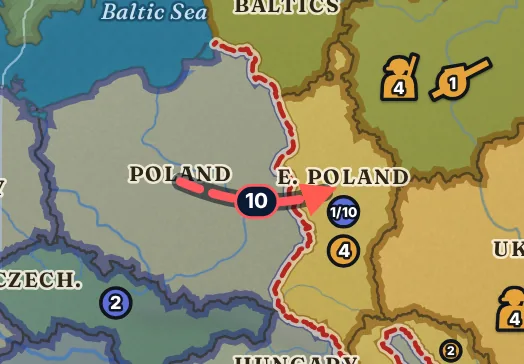
- Combat move. Move units into fights, amphibious landings, blitzes, and factory raids. Combat-moved units are marked and will fight (or raid) in the next step.
- Battles. Resolve pending fights, then raids. Sea fights are handled before land fights in the same turn, so a landing can depend on the fleet.
- Noncombat move. Move units that have movement left and did not make a combat move. AA guns only move here. The Soviet Union may take over nearby UK or US land and air units in Moscow, Leningrad, Stalingrad, or Archangel; those units then freeze for the rest of the turn.
- Deployment. Place purchased units at factories you held at the start of the turn (not ones you captured this turn). A home factory has no placement cap. Any other factory you are using is capped at that space's PP value. Ships go in a sea zone next to the factory.
- Fleet reset. Battleships that took one hit are repaired. Submarines that dived come back to the surface.
- Income. Add land PP and open convoy PP to your treasury, unless your capital is gone (then you get nothing). Germany also collects from Middle East spaces it holds — paid out of Allied treasuries.
The units
- Each type has move, attack, defence, and a cost in production points.
- A hit is a 6-sided die equal to or under the attack or defence value.
- InfantryMove 1 · Attack 1 · Defence 2 · Cost 3Foot soldiers. Attack at 2 when paired one-for-one with attacking artillery.
- ArtilleryMove 1 · Attack 2 · Defence 2 · Cost 4Guns. Each one lifts a single attacking infantry to attack 2.
- TankMove 2 · Attack 3 · Defence 2 · Cost 5Fast armour. Can blitz through one empty enemy land space, unless an enemy AA gun is there.
- AA gunMove 1 · Attack 0 · Defence 0 · Cost 5Never a casualty. Fires once at each enemy plane that enters or crosses its space, hitting on 1. Captured if left alone. Moves only in the non-combat step.
- FighterMove 4 · Attack 3 · Defence 4 · Cost 12Air cover. Lands on carriers. Escorts bombers at 1; intercepts raids at 2.
- BomberMove 6 · Attack 4 · Defence 1 · Cost 15Long-range strike. Can raid an enemy factory: each bomber that gets through knocks production points off that power's treasury.
- SubmarineMove 2 · Attack 2 · Defence 2 · Cost 8First strike when attacking, unless a destroyer is there. May dive out of a fight. Cannot hit planes.
- DestroyerMove 2 · Attack 3 · Defence 3 · Cost 12Cancels attacking submarines' first strike and lets planes hit submarines. Shore fire at 2.
- TransportMove 2 · Attack 0 · Defence 1 · Cost 8Carries one tank alone, or two other land units. Cargo sinks with the ship.
- CarrierMove 2 · Attack 1 · Defence 3 · Cost 18Holds two fighters.
- BattleshipMove 2 · Attack 4 · Defence 4 · Cost 24Takes two hits; repaired at fleet reset. Shore fire at 4.
Dice and hits
- Combat uses a 6-sided die.
- A unit hits when the roll is less than or equal to its attack value (if attacking) or defence value (if defending).
- A 0 attack or defence means that unit does not roll.
- Artillery support is re-paired each round: each attacking artillery raises one attacking infantry from 1 to 2.
Battles, step by step
- A fight starts in a space where your combat-moved units face enemy units (AA guns do not count as a defending force).
- Empty enemy land with your land units in it is captured with no battle.
- Shore fire (landings only). Battleships fire at 4 and destroyers at 2 from the unloading sea, if that sea did not just fight. Those hits come off the defenders before the first round, but the doomed units still fire in round one.
- Submarines' first strike (when attacking, and no opposing destroyer). Those hits are removed before the other side answers.
- Main volley. Everyone still in the fight rolls. Hits are assigned, then the next round begins unless one side is gone or the attacker retreats.
- Landings from the sea cannot retreat. Other attackers may.
- When several Allied powers defend the same space, they share one casualty order if their saved preferences match. If those orders disagree, the attacker picks the defending losses.
- Planes cannot hit submarines unless a friendly destroyer is in the fight (or already in the zone). Submarines cannot hit planes.
- A fight that is only planes against only submarines, with no destroyer, is not fought at all.
Casualties and battleships
- Most units die on one hit.
- A battleship takes two: the first damages it, the second sinks it.
- Damage is repaired at fleet reset if it survives the turn.
- AA guns are never chosen as casualties; if they are left alone in a captured space, they change hands.
Raids and anti-air
- Bombers (with or without fighter escorts) can raid an enemy factory instead of joining a ground fight.
- Fighters may intercept. Escorts fire at 1, interceptors at 2.
- Each bomber that gets through rolls one die, and that many production points come off the raided power's treasury (capped at what they actually have).
- AA guns in a space fire once at each enemy plane that flies into or through, hitting on 1.
- They do not fire as a normal defending unit in a battle.
Tanks, blitzes, and landings
- A tank that still has movement can blitz: it may pass through one empty hostile land space (capturing it) and continue, unless an enemy AA gun is in that space.
- A transport carries one tank alone, or two other land units.
- Cargo is lost if the transport sinks.
- Units unloaded in combat are amphibious: they fight, and they cannot retreat.
Ships and convoys
- Allied convoy lanes add PP at Allied income.
- A German warship that enters a lane cuts it until an Allied warship sails through.
- The Arctic lane also needs Archangel in Soviet hands.
- True neutrals (Spain, Spanish Morocco, Sweden, Switzerland, Turkey, Saudi Arabia) cannot be entered or flown over.
Factories and the map
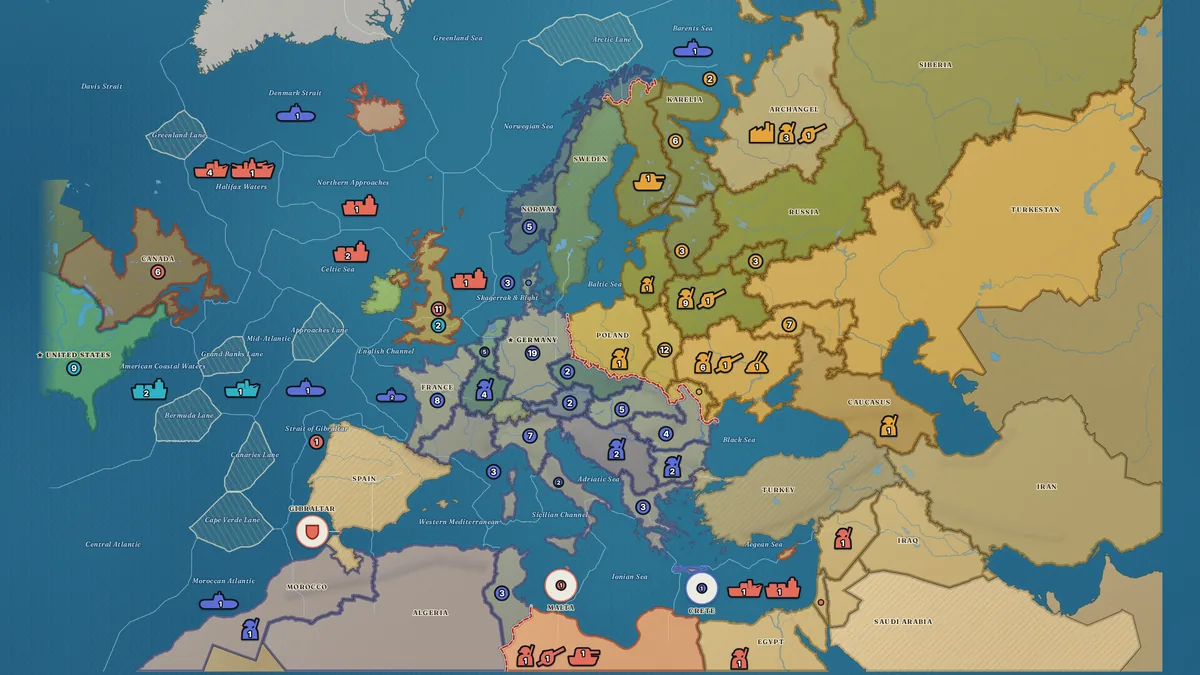
- Factories start on Germany, Northern Italy, Moscow, Leningrad, Stalingrad, Archangel, the United Kingdom, Canada, and the United States.
- You deploy only at factories you held when the turn began.
- Home factories (the ones printed for that power) have unlimited placement; others are limited to the space's PP.
- Captured factories can still be raided.
The Middle East
- Middle East spaces are Allied-leaning land that never takes a turn.
- If Germany holds one, its PP is paid to Germany at German income, taken from Allied treasuries.
- Allied preferences decide who pays first; where they leave it open, Germany chooses the order.
Defender preferences
- Each player saves a casualty order (land and sea) and a few convoy / Middle East choices.
- Those orders are used whenever that power is attacked.
- They do not change the rules; they only pick which unit is lost first.
After you send
- A short briefing lists what moved.